Our process

A clear route from audit to launch.

Good redevelopment is not a leap from an old website to a new one. It is a sequence of decisions, each grounded in evidence and signed off before the next stage begins. You know what is happening, what you receive and what we need from you.

Starts with
Your business, audience and current website
Output per stage
A tangible decision, artefact or working improvement
Your involvement
Insight early, focused review and sign-off at gates
Ends with
A controlled launch and a plan for what follows

The seven stages

Each stage turns a question into something usable.

The exact depth varies with the scope, but the order protects the work from expensive guesswork. We do not design around assumptions that should have been checked first.

01

Discover

We learn how the business operates, who the website needs to serve and what a useful next step looks like. We discuss your offer, audiences, internal responsibilities, existing tools and the points where enquiries or decisions currently stall.

What you receive
  • A shared project brief and agreed priorities
  • A map of audiences, offers and desired actions
What we need from you
  • Access to the current website or a guided tour
  • Your view of what is working, failing or changing
02

Audit

We examine the current site across structure, user experience, responsive behaviour, performance, technical SEO, content, conversion paths, forms, security and maintainability. We look for causes rather than collecting a list of cosmetic preferences.

What you receive
  • A prioritised audit with evidence and recommendations
  • A clear view of keep, improve, replace and retire decisions
What we need from you
  • Relevant logins or exports where available
  • Context for unusual traffic, content or technical constraints
03

Strategize

We turn the discovery and audit into a delivery plan: information architecture, page roles, content responsibilities, technology choices, integrations, measurement and dependencies. The roadmap sets a sensible order for decisions rather than treating every page as equally urgent.

What you receive
  • A recommended structure and prioritised roadmap
  • A defined scope, delivery approach and decision list
What we need from you
  • Confirmation of priorities and decision-makers
  • Existing brand, content and system information
04

Design

We design the experience around the agreed structure, beginning with hierarchy and journeys before refining the visual language. Key page types become reusable patterns, so the site feels coherent without every page being forced into the same mould.

What you receive
  • Page designs and a reusable interface direction
  • Responsive layouts with content and interaction guidance
What we need from you
  • Timely review from the agreed reviewers
  • Brand assets, subject expertise and clear design decisions
05

Develop

We build the approved structure with clean, standards-based code and a CMS that suits the people who will maintain it. Templates, forms, integrations and automation are connected deliberately rather than added as isolated patches.

What you receive
  • A working site in a review environment
  • Configured templates, forms, integrations and content structure
What we need from you
  • Final or near-final content and required account access
  • Prompt clarification when build decisions affect scope
06

Optimize

Before launch, we test the experience on relevant screen sizes and check the pathways that matter: navigation, forms, content clarity, performance, technical SEO, accessibility, tracking and error handling. We refine the work against the agreed requirements, not personal preference.

What you receive
  • A tested release candidate and launch-readiness list
  • A record of fixes, checks and any agreed follow-up items
What we need from you
  • Review of content and key journeys
  • A practical test of forms, approvals and internal handovers
07

Launch

We plan the release, confirm redirects and tracking, coordinate the deployment and check the live site immediately afterwards. The changeover is controlled so there is a clear point of responsibility and a way to identify anything that needs attention.

What you receive
  • A live, checked website and launch handover
  • A practical list of ongoing maintenance and growth priorities
What we need from you
  • Final approval and an agreed launch window
  • Access to hosting, domain and connected services where required

A working artefact

The process should leave you with something you can use.

Stages are not disappearing boxes on a project plan. They produce decisions and working materials that make the next conversation more concrete.

Structure before decoration.

Page roles, journeys and content responsibilities are resolved before visual polish hides a structural problem.

Dependencies stay visible.

Forms, booking, analytics and other connections are considered while there is still time to test them properly.

Review has a decision.

Each gate records what is approved, what needs clarification and what is deliberately left for later.

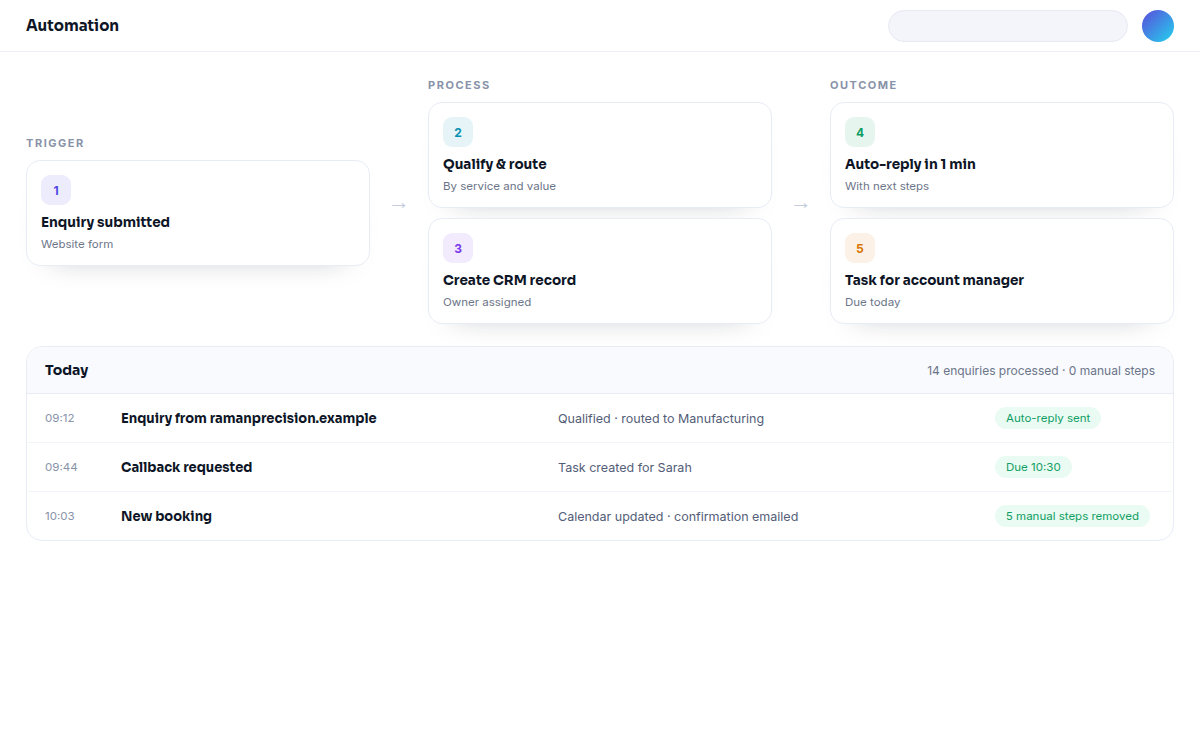
yourbusiness.com — workflow map
A light automation workflow map showing connected steps, handoffs and a clear human checkpoint.

A representative workflow view: the exact tools and steps depend on the systems already used by the business.

How we communicate

Clear updates, clear decisions.

Communication is part of delivery. We keep the next decision visible and give the right people a chance to make it.

Updates with a purpose.

We report progress, blockers and the next action without making you interpret a stream of activity.

Sign-off gates.

Discovery, strategy, design and the release candidate each have a clear review point before the next stage.

Useful review rounds.

We ask for consolidated feedback from the agreed reviewers, keeping revisions focused and consistent.

Scope changes are explained.

If a request affects scope or launch, we show the impact and options before doing the work.

What can affect a timeline

The schedule follows the decisions and dependencies.

We do not promise a fixed number of weeks before understanding the scope. A typical site moves faster when decisions, content and access are ready; dependencies still need room.

Number of pages

Multiple services, audiences, locations or migrations require more decisions than a focused set of page types.

Content readiness

Writing, approvals, imagery and accurate service information affect the move from design to build.

Approvals

A named decision-maker and consolidated feedback keep gates useful and avoid rework.

Integrations

CRMs, booking, payments, analytics and automation need access, testing and agreed data behaviour.

Third-party dependencies

External platforms, hosting, domains and approvals can add steps outside our control.

Changing priorities

New requirements need an impact check before they displace agreed work or change launch.

Process questions

What clients ask before we begin.

Sometimes the honest answer is “it depends”. The process turns that uncertainty into a decision before the build.

It depends on page types, content, integrations, approvals and technical change. We confirm a staged schedule after discovery and audit.

Business context, access to the site and relevant systems, existing assets, and timely decisions from the agreed reviewers.

Tell us early. We will explain the impact and whether the request should replace, move or become later work.

Yes. An assessment or focused improvement can be a sensible first step when it is structured for the wider website.

We complete the handover, check the live experience and agree next actions. Ongoing support can be scoped separately.

You retain ownership of the website, content, domain and relevant accounts. We make access and responsibilities clear at handover.

Ready for a process with fewer surprises?

Send us the current website and tell us what has changed in the business. We will help you identify the right first stage, even if that is not a full redevelopment.